Outdoor Experiences
Retreats
Weddings

Travel tends to assume comfort and nature sit at opposite ends of a spectrum. Usually that holds: to experience the outdoors you rough it, and to sleep somewhere beautiful you take a parking-lot view. Then you stay somewhere that breaks the trade, and the reason is always the same: the building and the site were designed for each other. The five design-forward nature retreats here all work that way; seamlessly blending the luxury of a five-star resort with the tranquility of a wilderness escape.
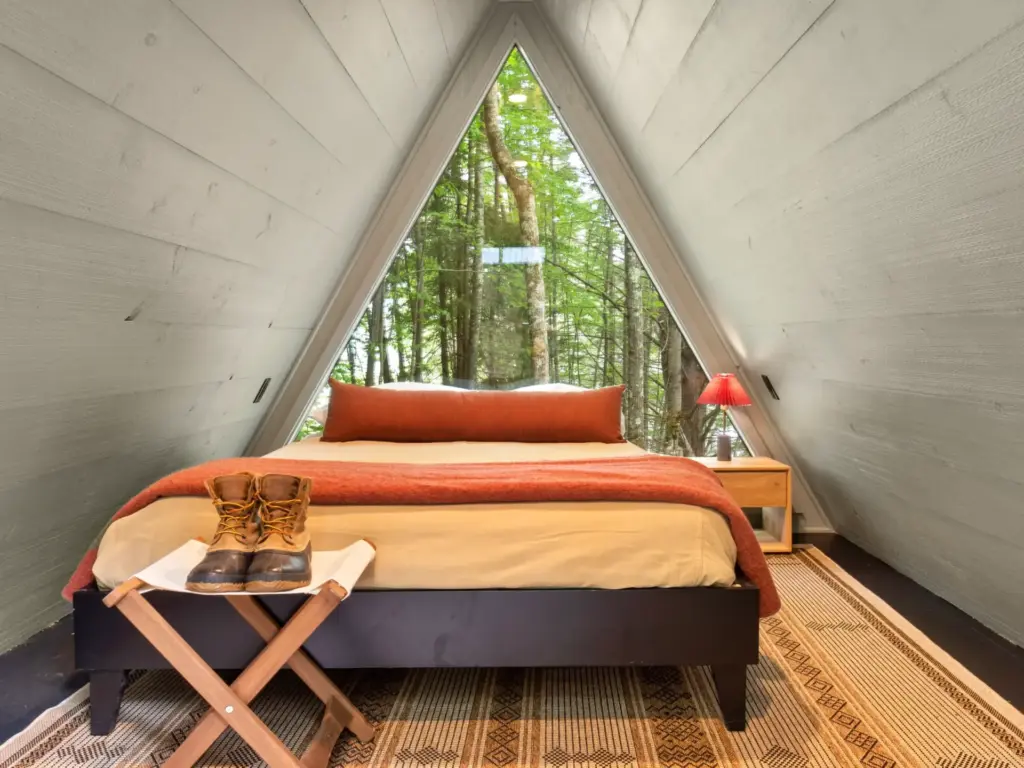
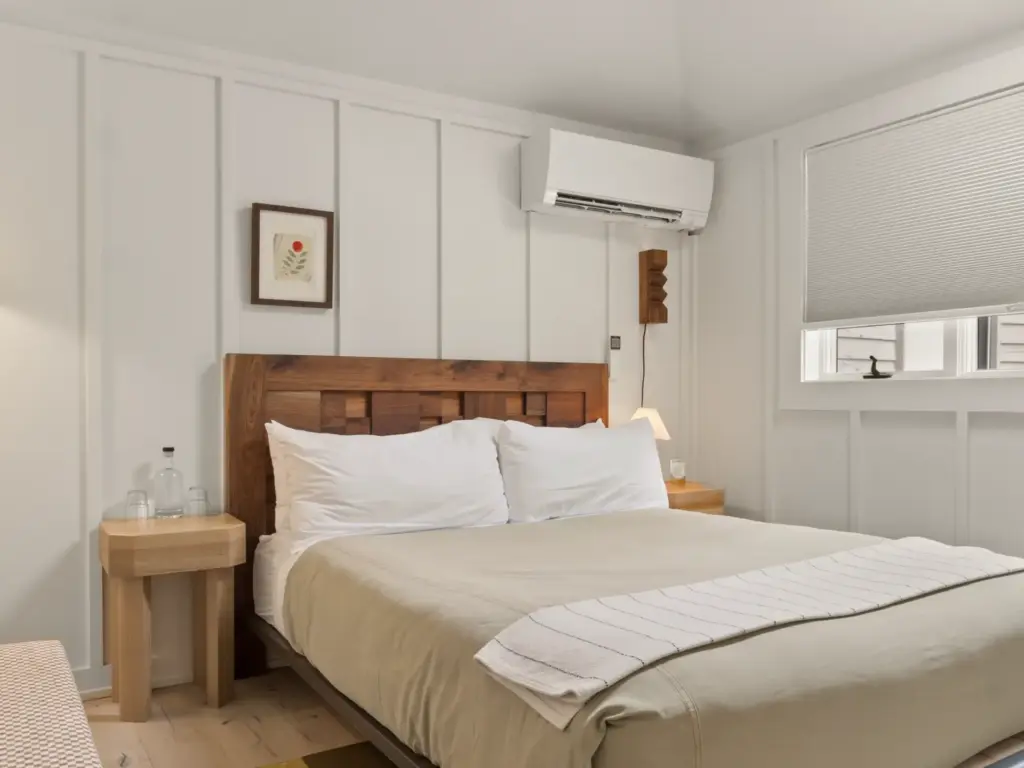

The original house at Callicoon Hills dates to 1905, and by the 1940s it had established itself as a resort. Then came the Catskills’ Borscht Belt boom, the era that defined summer leisure in Sullivan County for generations. That chapter closed, but the bones stayed.
Post Company, a Brooklyn-based design studio, took on the redesign. What the studio didn’t do is the interesting part: it didn’t gut the place. Callicoon Hills reopened with its creaks and odd corners intact, a century of summers still legible in the woodwork.
The Catskills have seen real hotel development lately, with new properties across Sullivan and Ulster Counties. Callicoon Hills stands out for how much of the region’s layered history it kept. Coverage in Domino, Remodelista, We Heart, and the MICHELIN Guide reflects that.
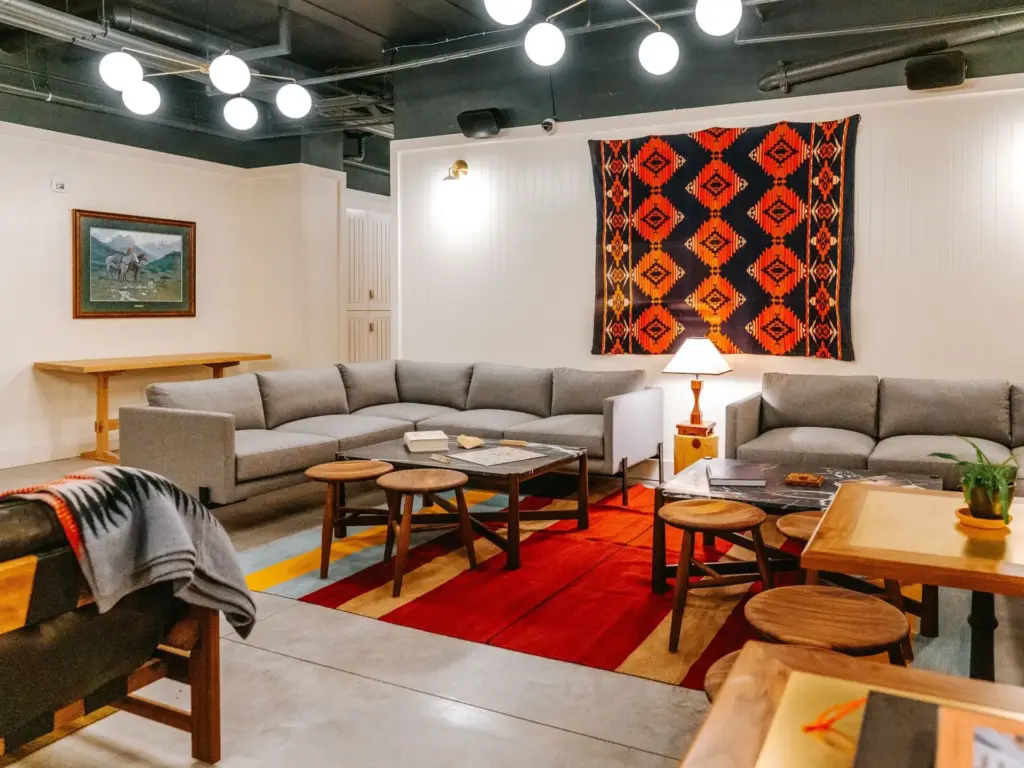
The palette is the first thing you notice: dark forest green, tan, rust, and sage — colors that echo the hillside outside the window rather than announcing themselves. Board and batten paneling lines the walls. Scalloped, chunky furnishings fill the rooms with a cheerful weight, and black painted floors contrast against the warmth above them.
Post Company’s Leigh Salem describes the approach:
“The color palette stemmed much from the surrounding landscape of the Catskills.”
The interiors don’t feel designed so much as discovered. Salem inherited a century of accumulated character: odd proportions, unexpected architectural moments, and rooms that didn’t quite follow a plan.
Most studios would smooth that out. Post Company leaned in.
“We inherited many charming and quirky architectural moments in the property, so we wanted to embrace the idiosyncrasies and character. The goal was to have the space exude a residential feel, like the home of the consummate host.”
That tagline — “An Informal Vacation Resort” — came off old hotel collateral from the property’s earlier life. Callicoon Hills adopted it as its own.
Sixty-five wooded acres surround the property: a mountain valley, creek access, a pool, A-frame cabins, fire pits and porches built for lingering. None of it is bolted onto the hotel. In fact, it’s the reason the hotel takes the shape it does.
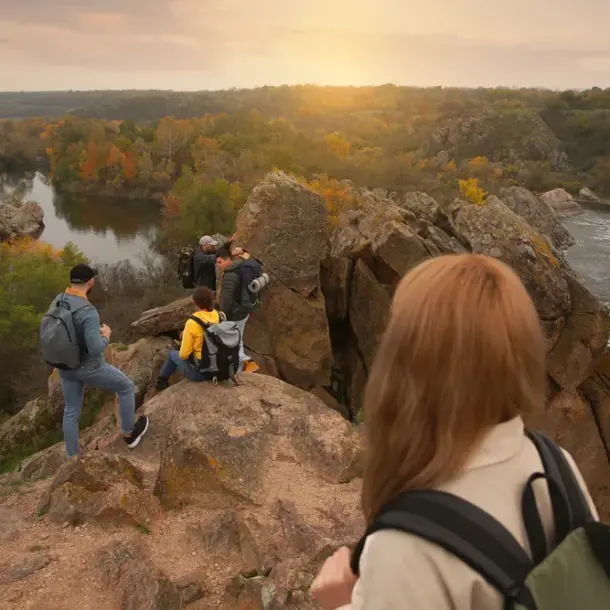
The MICHELIN Guide calls the property “right at home in the boutique-hotel era of the 21st century.” What that misses is how deliberately the inside and the outside talk to each other. Specifically, rust tones answer the autumn hillside, and the dark wood panel surfaces recall the forest floor. Sit on a porch here in October during sunset, and you’ll watch the whole scheme resolve at once.
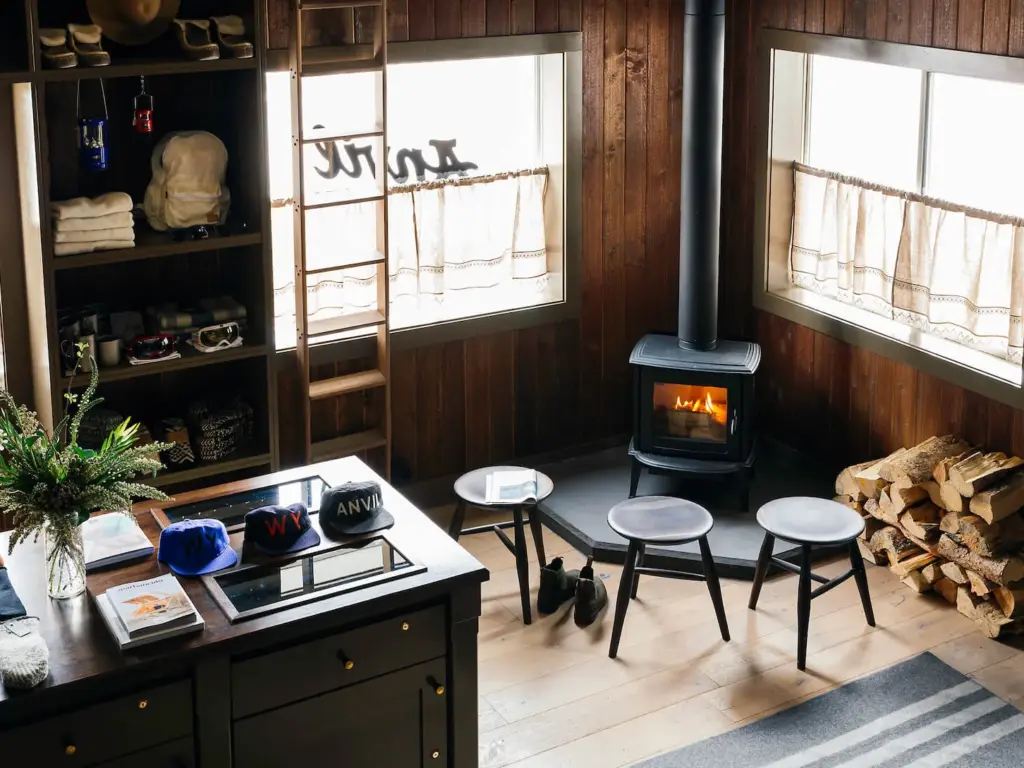
The Anvil Hotel sits on a site with a clear past: a two-building 1950s roadside motel above a blacksmith’s workshop, the detail that gave the new hotel its name. Brooklyn-based Studio Tack took on the renovation. They found exactly the raw material they work best with — a building that had already lived a life.
Studio Tack kept the original neon sign. It reads: “You’re a Stranger Here But Once!” Today that phrase appears on the matchbooks at Glorietta Trattoria, the hotel’s restaurant.
It’s a small thing. Still, it tells you most of what you need to know about how the studio approaches a project. This place has an elegant yet lived-in vibe that just feels like home.
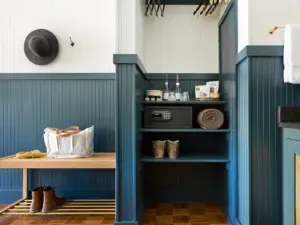
Jackson’s design vernacular has a default setting: blond woods, mounted animal heads, southwestern textiles. There’s nothing wrong with any of it, and you’ll see it all over town. Studio Tack chose none of it. The exterior is dark mountain-green.
Inside, navy and brass sit alongside cork and parquet floors, black-tiled bathrooms, and custom metal beds with brass accents. Wool throws and patterned rugs finish the rooms. The lobby works as café, boutique, and gathering room, a wood-burning stove at its center. It’s less a place to sleep than it is a basecamp.
Studio Tack described the renovation’s core intent in an interview with Dezeen:
“In its new iteration, the property’s dark mountain-green exterior is complemented with interiors that have been transformed to embody the sensibility of Jackson’s rugged terrain and the aesthetic culture of the Teton region.”
An older building sounds like a constraint. Yet to the right designer, it’s closer to a resource. Studio Tack’s Ruben Caldwell explained this to Metropolis:
“We’ve learned to embrace any and all of the eccentricities that come along with an older property — and we celebrate what we find, using it as a means to create a unique experience that can’t necessarily be planned or designed from scratch.”
The MICHELIN Guide’s verdict on the result: “It’s new, but it feels like it’s been here forever — always a sign of a fine hotel.”
Anvil Hotel is the main event, with Cache House — a 50-bunk design hostel under the same ownership — directly below. That’s why the pair works for groups on mixed budgets. Whether you’re in one of the private suites or the shared living space, you’ll be in curated comfort. Their location in the town of Jackson puts Grand Teton National Park and Yellowstone within reach. The design doesn’t compete with that proximity: it prepares you for it.
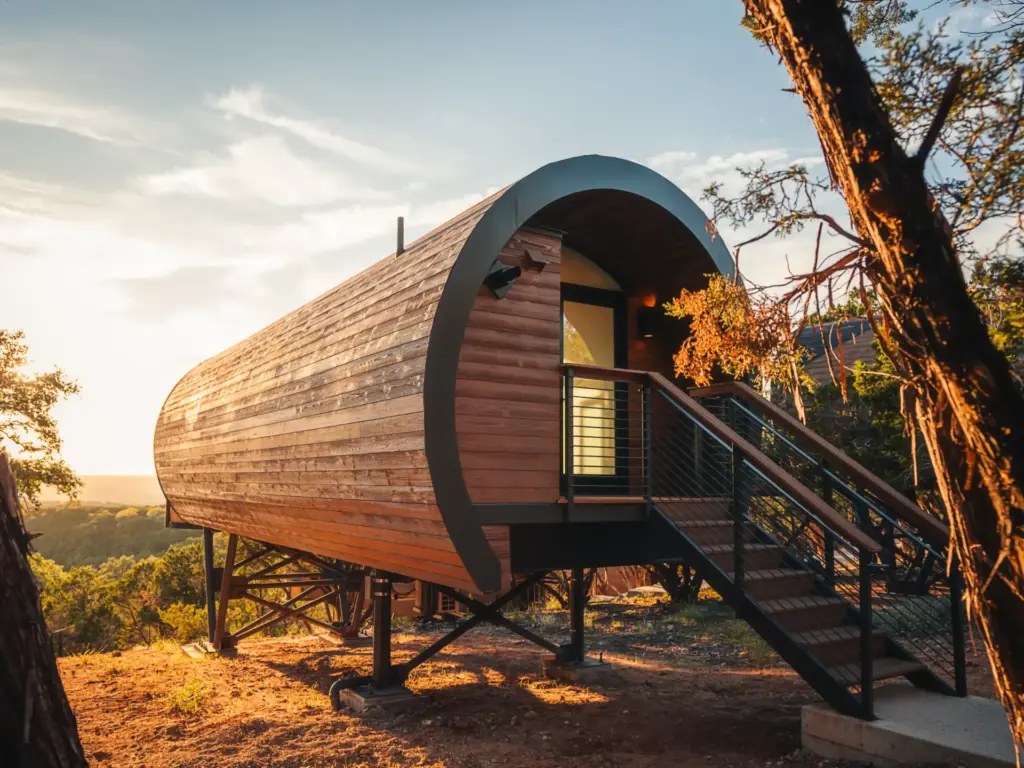
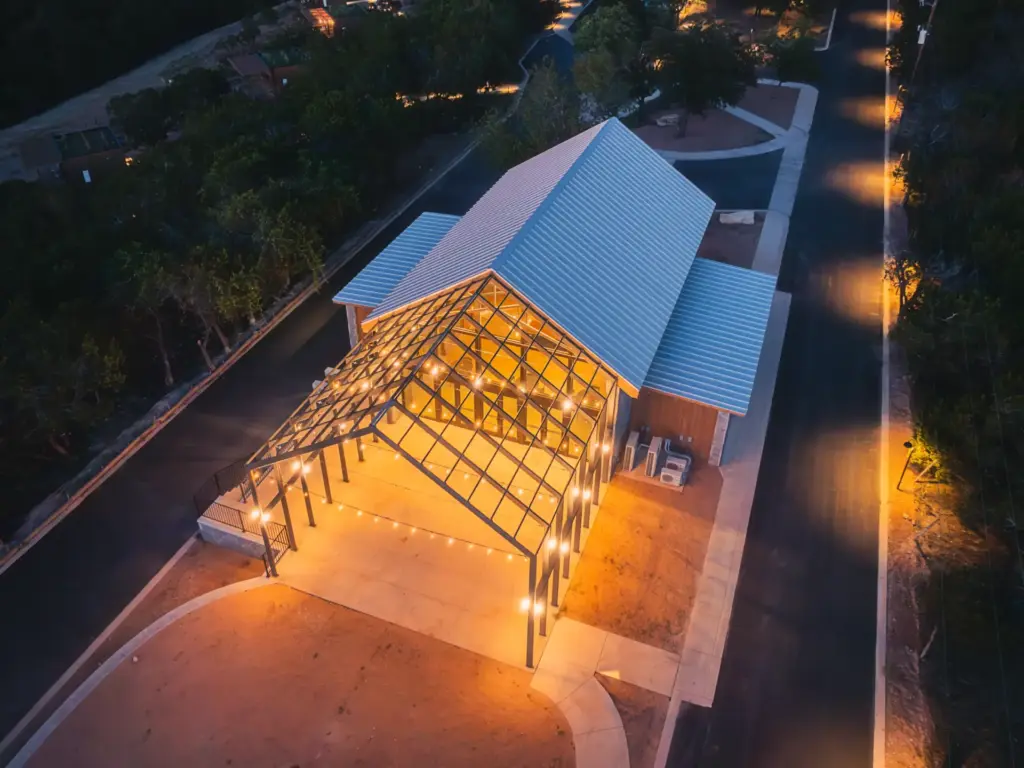
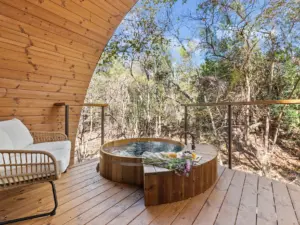
Most hotels ask you to choose a room type. Onera asks you to choose a structure.
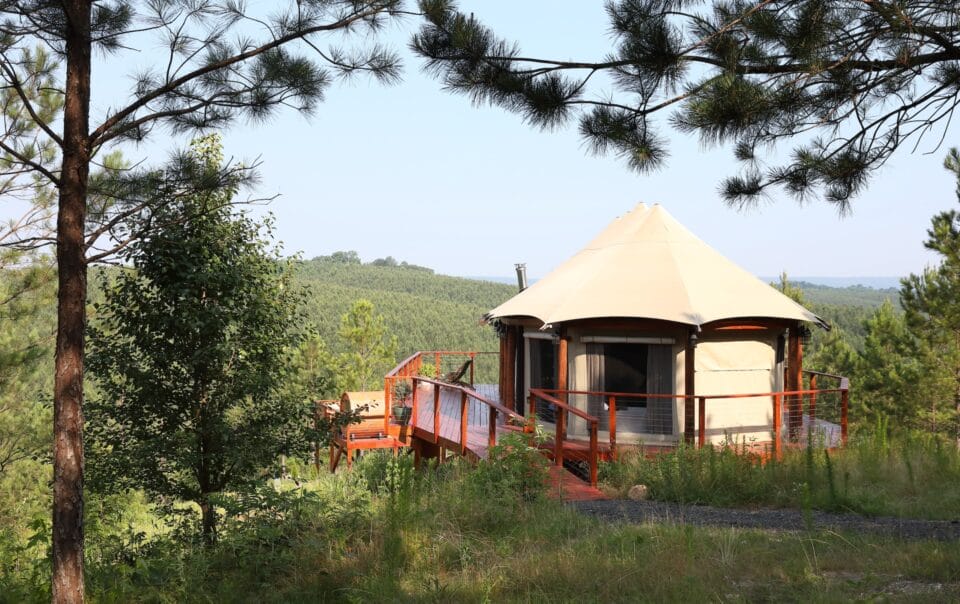
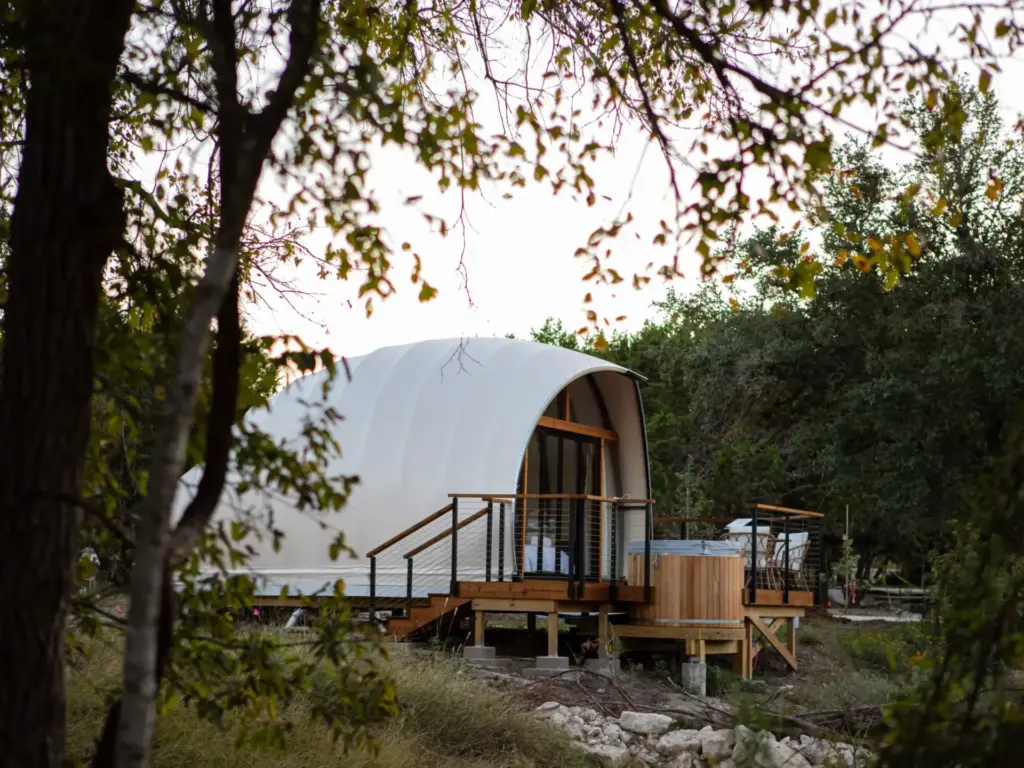
The flagship Hill Country property, Onera Fredericksburg, expanded to 35 units in fall 2025. Each one is a distinct sculptural form set among the oaks and cedar. Onera Wimberley opened in 2024 as a sister property with the same design identity.
The lineup reads like a catalog of architectural experiments: the barrel-shaped Spyglass on stilts, the butterfly-inspired Monarch, the whipped-cream swirl of the Cocoon, container conversions like Live Oak Lodge and Walnut House. UNIQ Hotels puts it plainly:
“You’re not just booking a room here — you’re choosing from a catalog of creative interpretations of what it means to live among the trees.”
These architect-designed retreats offer something most luxury nature stays can’t: variety. Book twice, or even more times, and you haven’t repeated yourself.
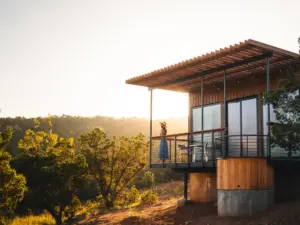
Sustainable materials and floor-to-ceiling glass dissolve the boundary between inside and outside. Cedar soaking tubs and private decks push living space up into the canopy.
Light matters here, though not in the usual hospitality sense. Both Onera locations sit in certified International Dark Sky Communities: minimal light pollution is designed, not accidental. Step outside after dark and the sky becomes part of the architecture.
UNIQ Hotels describes the aesthetic as luxury accommodations “that feel more like sculptural art pieces than nostalgic backyard hideouts.” The distinction matters, because this is design-led glamping at a register most properties don’t reach.
CEO Jon Cole put the appeal in straightforward terms in an interview with Modern Campground:
“The beauty of Onera is that it offers the best of both worlds.”
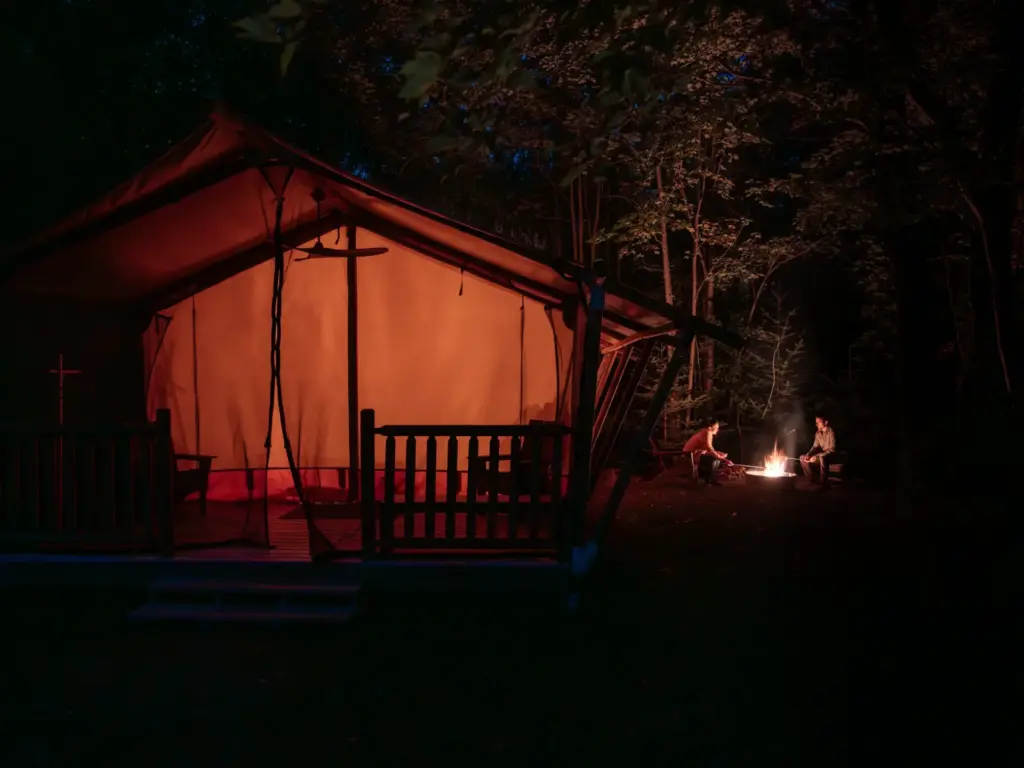
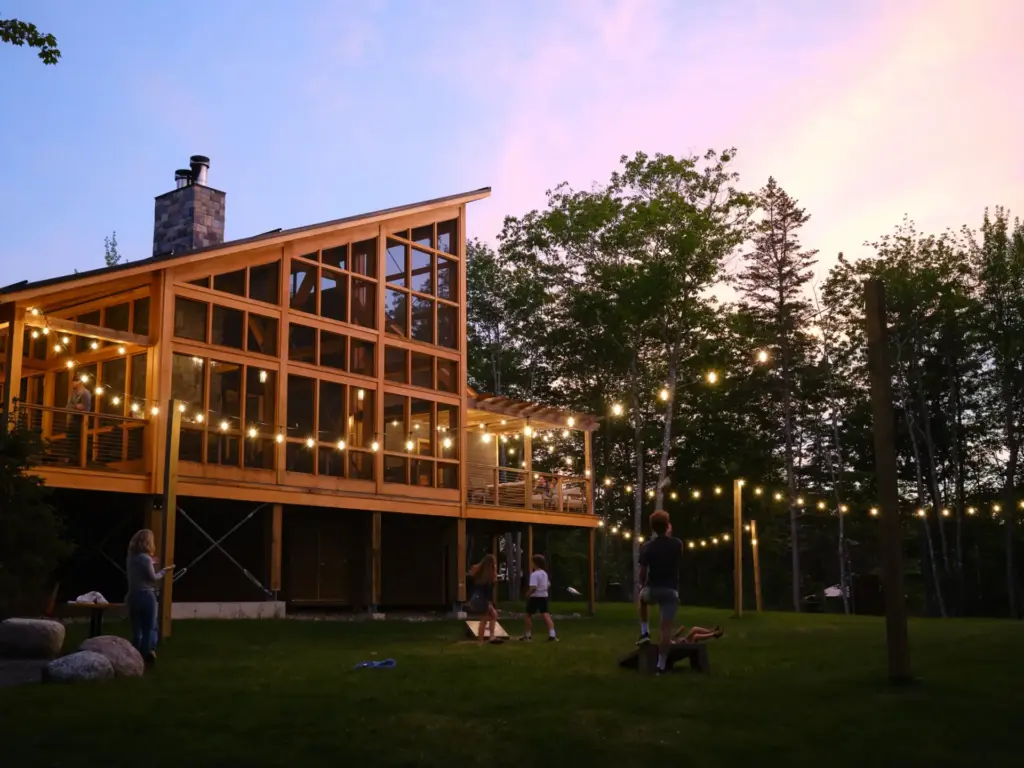
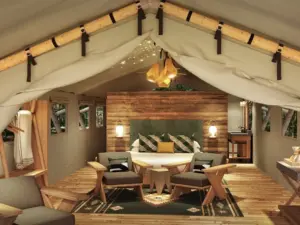
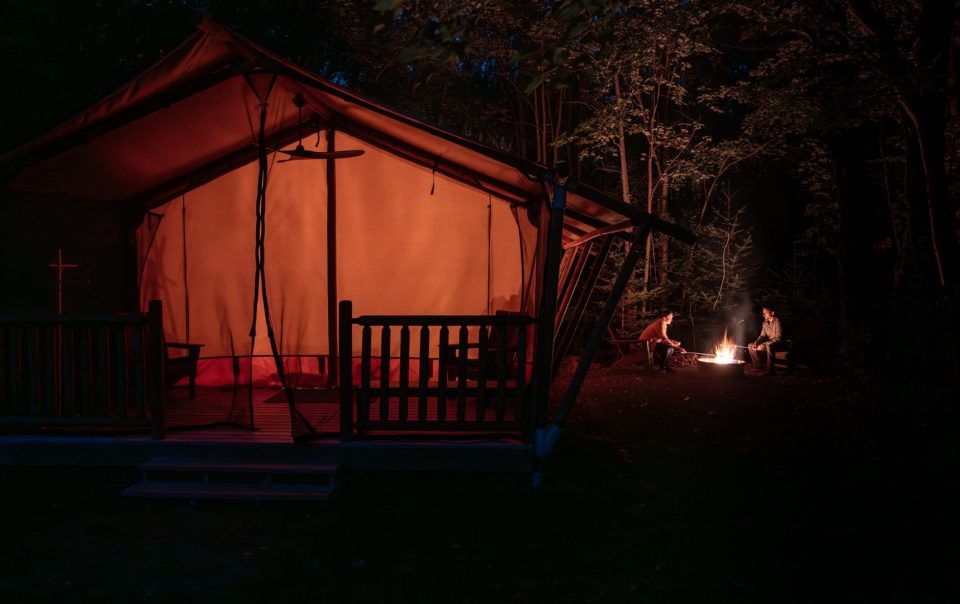
Sixty-four canvas tents spread across a wooded property, 15 minutes from both Bar Harbor and the Mount Desert Island entrance to Acadia National Park. On paper, that’s camping. In practice it’s so much more: Terramor Outdoor Resort is a sanctuary that happens to be built from canvas.
The tents include exposed finished wood beams, premium beds and linens, and hotel-grade en suite bathrooms. Notably, those bathrooms come with double vanities and walk-in showers, and some tents add a private outdoor shower. The standard of finish is consistently high — not aspirationally, but genuinely so.
We3Travel captured the distinction well:
“The modern design reminded me of the stylish Under Canvas tents, but they went a step beyond.”
The central lodge anchors the social life of the property. A restaurant, bar, camp shop, and gathering spaces give Terramor a community feel. Still, the individual tents keep their privacy: you decide how much of the resort you want on any given evening.
Acadia National Park is the real co-star. Trails, coastline, and Atlantic wilderness sit minutes away, and the park shapes how you experience the rest of it.
KOA president and CEO Toby O’Rourke articulated the philosophy in the resort’s launch announcement:
“The name Terramor blends ‘land’ and ‘love,’ which reflects our approach to personalized hospitality and celebrating the benefits of time spent in nature.”
That philosophy shows up in the details. At launch, KOA described the tents as “thoughtfully designed to blend the aesthetics of the surrounding nature with the comforts of an upscale hotel room.”
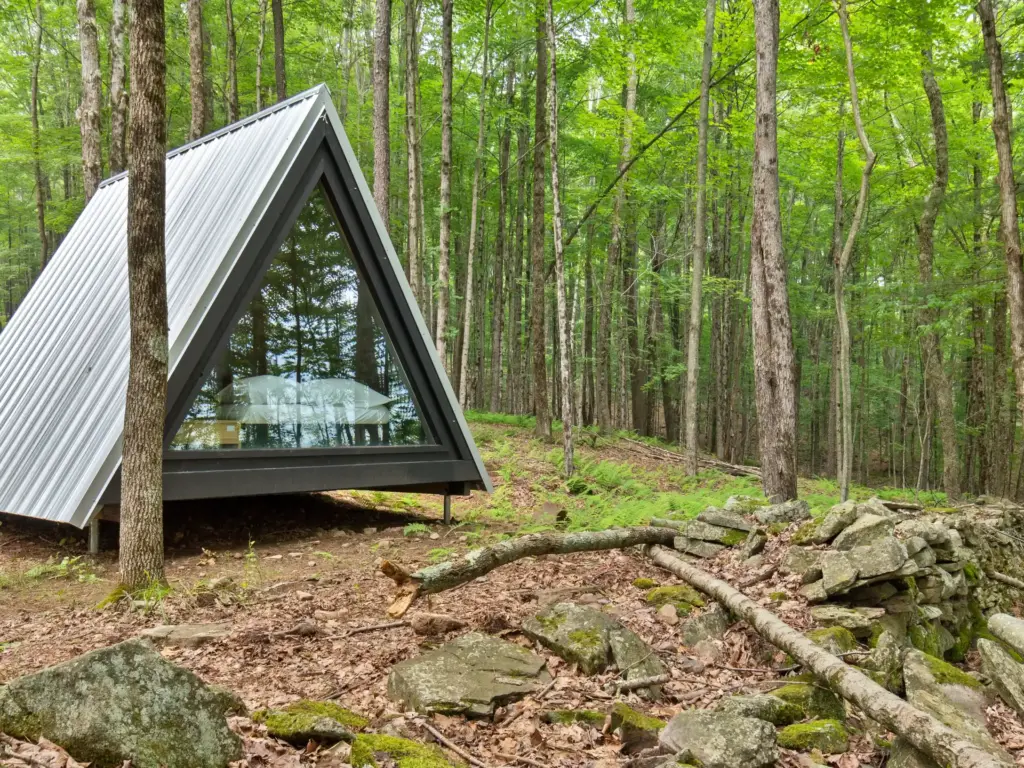
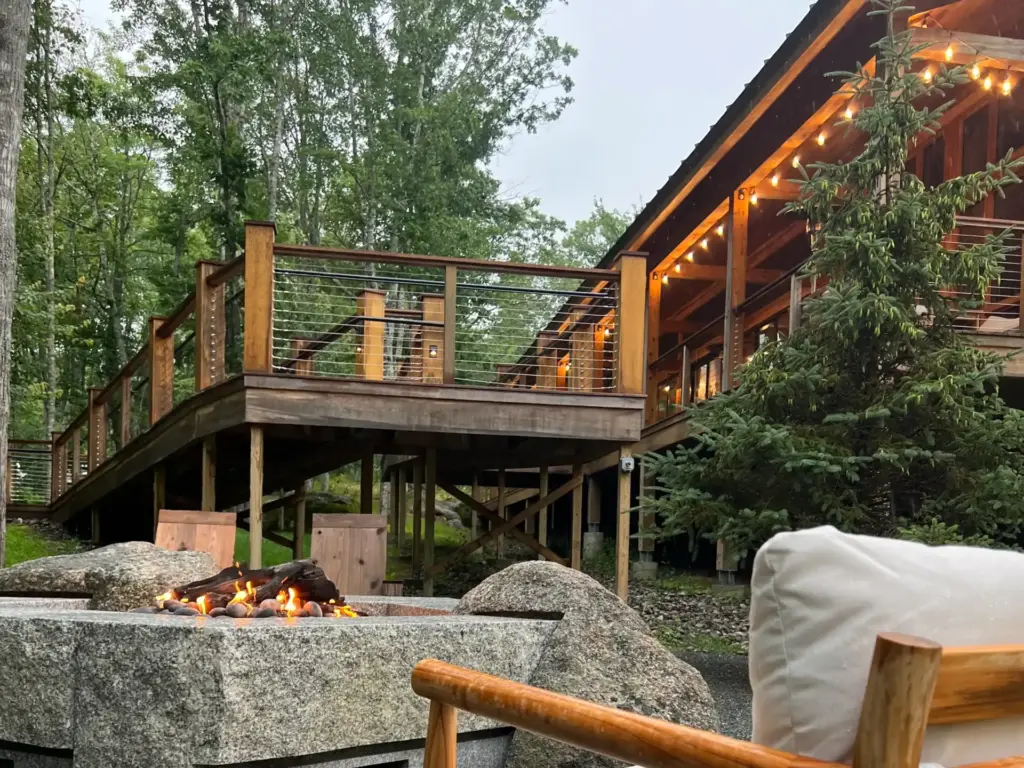
A few principles run through all five. First, design serves the setting instead of competing with it. Callicoon Hills draws its palette from the Catskills hillside, Anvil Hotel mirrors the Wyoming terrain, and Onera glazes floor to ceiling so the trees come inside. Comfort is never sacrificed, though it never becomes the whole story either.
Each property also runs on one strong idea executed with conviction. Callicoon Hills is built on nostalgia, edited and sharpened. Anvil Hotel is built on restraint, on what it deliberately didn’t use.
Onera is built on formal ambition: the idea that a place to sleep can also be a sculptural object. Finally, Terramor is built on the belief that canvas and luxury aren’t contradictions.
Nature access, in every case, is a designed feature. Not an afterthought. Not a selling point applied after the fact. You rest better in places that were actually thought about, and the outdoors is the reason these buildings take the shape they do.
Nook Outdoors curates stays with exactly this standard in mind: properties where thoughtful design and genuine outdoor access reinforce each other rather than trade off. Explore the full Nook Outdoors collection to find your next design-forward nature retreat.